

TopClass LMS Features
All-In-One LMS
.svg)



If you manage professional education, you know that the gap between "attending a course" and "mastering a skill" is wide. Merrill's principles of instruction provide the bridge. While many frameworks feel like academic theory, Merrill's model addresses how learners process, retain, and apply new knowledge in high-stakes environments.
Developed by educational researcher M. David Merrill, Merrill's principles of instruction are rooted in real-world problem-solving. When your educational programs follow this blueprint, learners don't just consume information; they gain the competence to apply it immediately. To help you apply this instructional model, we'll cover the following:
Let's explore how to use Merrill's framework—backed by the right learning management system (LMS)—to ensure your members can apply what they've learned.
Mastering Merrill's principles of instruction allows your courses to move beyond content delivery and toward true skill mastery. These FAQs address common questions about the framework's practical benefits and how to adapt it for the fast-paced world of association learning.
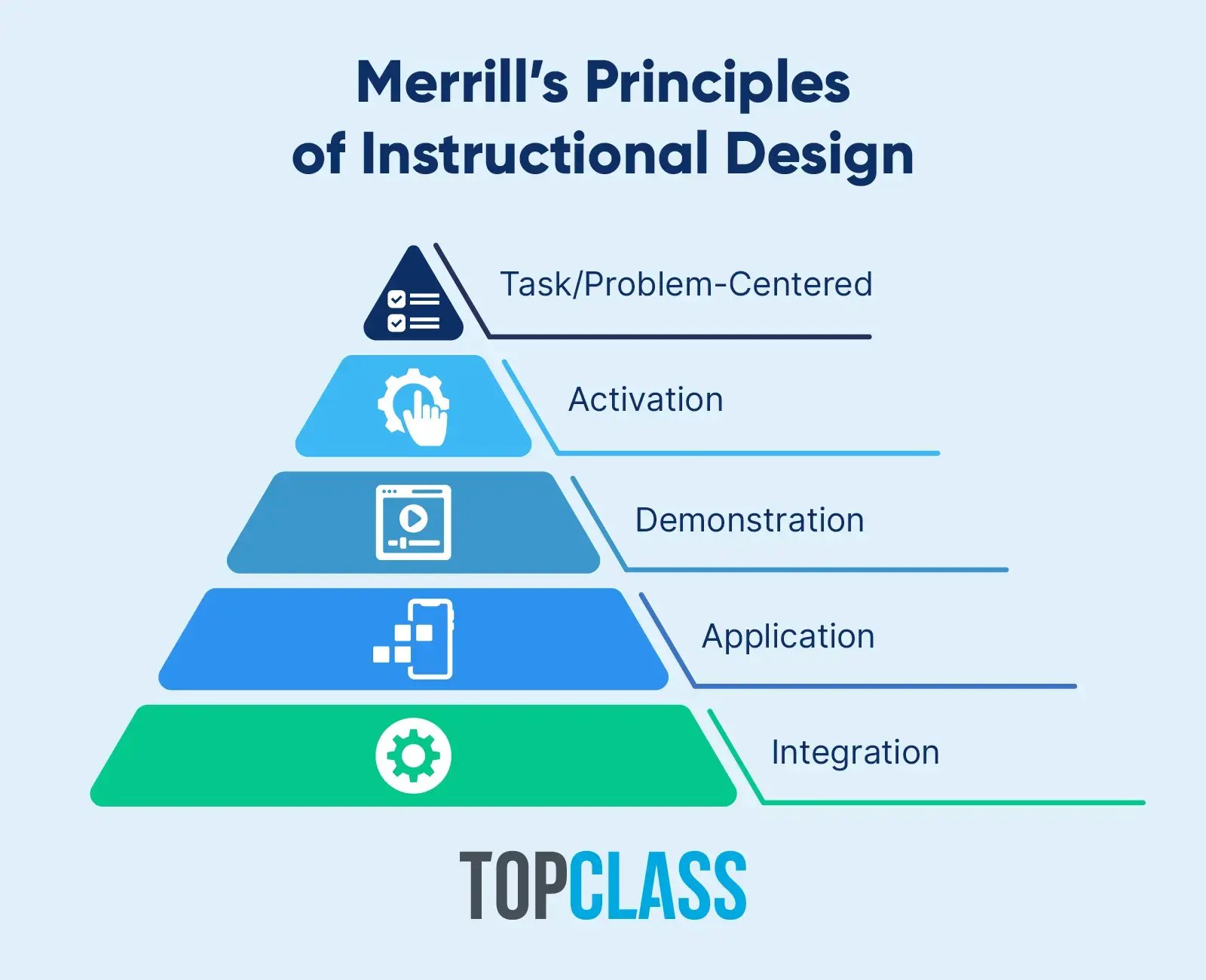
Merrill's principles are an instructional theory composed of five task-centered phases designed to maximize how learners acquire and retain new skills. These phases include:
Unlike models that focus on how to deliver content, Merrill's principles of instruction focus on how to structure the learning experience around real-world tasks. By centering the curriculum on a specific problem the learner needs to solve, this framework ensures that every piece of information provided is relevant and actionable.
Here's a video from Dr. Merrill explaining his perspective:
To help your association decide if this model is right for your learning program, here is a breakdown of the benefits and challenges of Merrill's principles of instruction.
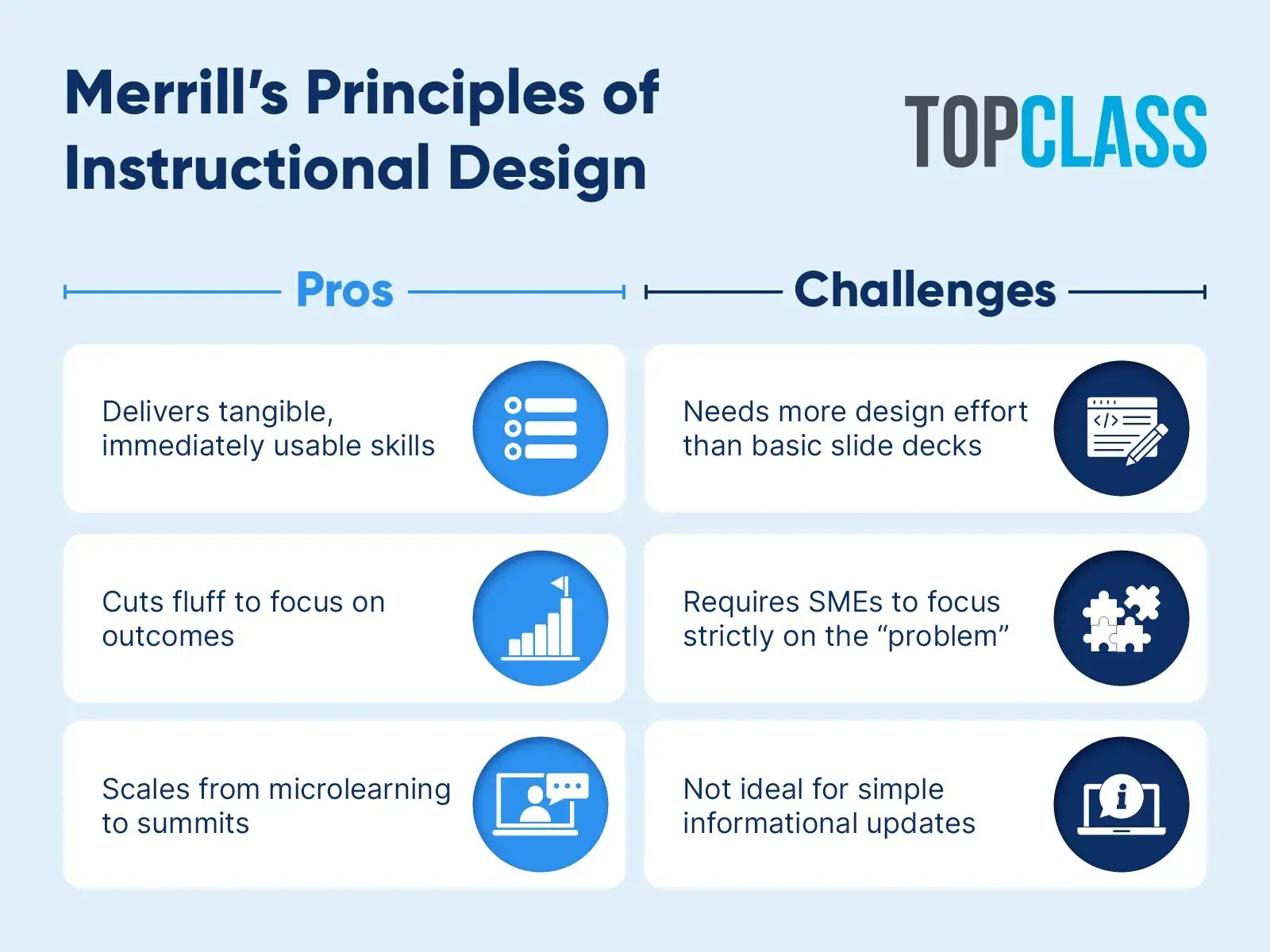
The Pros for Associations:
The Challenges:
The challenges of this model—mainly the development time—are usually offset by increased member satisfaction. When members realize your courses actually help them do their jobs better, they are far more likely to renew their membership and recommend your programs to others.
Yes, you can adapt Merrill’s principles of instructional design to shorter educational opportunities. Whether you're creating an asynchronous certification course or a live 30-minute webinar, you can follow the cycle: start with a real-world member problem, activate their experience with a quick poll, demonstrate a 5-minute solution, let them apply it via a chat-based exercise, and close with an integration "homework" prompt for their workday.
Merrill believes the following five distinct phases must occur for effective learning to take place. If any of these "gears" are missing, the instructional engine stalls. Let's break down how each phase transforms a passive observer into an active problem-solver.
In his explainer video, Dr. Merrill stated, "Truly effective learning experiences are rooted in problem-solving." For associations, this is an ethical and practical choice; it ensures your programs are worth a member's time and money. By centering a course on a relevant, high-stakes problem, you immediately capture a learner's interest and engage their professional curiosity.
Before introducing new concepts, you must trigger the learner's existing knowledge. You can do this by relating new information to their past professional experiences. This helps them build a mental bridge from what they know to what they are about to learn. If they lack prior experience, provide a foundational mental model or a basic case study before introducing complex theories.
Dr. Merrill said, "Educators must show vs. tell." At this stage, learners are observers. To be effective, you must provide multiple relevant examples. Depending on the skill, use videos, infographics, or role-playing to:
Merrill believed that simple multiple-choice quizzes are insufficient for true mastery. True application requires the learner to actually do the work in the context of a real-world problem.
Help learners apply new knowledge and learn from any mistakes. Provide guidance at the start and then gradually reduce support.
Retrieval practice is an example of the application principle. Activities such as quizzes, role-playing, reflection, and discussion provide opportunities for the learner to retrieve and apply new knowledge. Merrill recommended exercises that allow the learner to apply new knowledge in different scenarios. Here's how that might look:
The true test of an educational program is whether the knowledge survives the transition back to the workplace. Integration is where theory becomes a permanent professional habit. Give your members opportunities to:
When members successfully weave these new skills into their daily routines, your training becomes a vital career asset. This final phase ultimately drives measurable ROI for your members (e.g., better workplace performance, compensation, promotions) and cements the value of your association’s educational offerings.
While Merrill's principles provide the pedagogical blueprint, the right technology brings that design to life. To implement this framework at scale, you need a digital environment that supports interactivity. A modern association LMS like TopClass acts as the engine for Merrill's principles of instruction, transforming static content into an interactive learning cycle.

By leveraging built-in platform features, you can scale the phases to thousands of members:
By using an LMS to automate these steps, your association can move from simply hosting videos to delivering a high-value, competency-based education program.

Instructional designers rarely use just one framework. While Merrill's principles of instruction focus on the "how" of the learning experience, they work in perfect harmony with the other models in our Learning Science Made Easy series:
For instance, you might use ADDIE to manage the overall project lifecycle (Analysis, Design, Development, Implementation, and Evaluation) while using Merrill's principles to design the actual learning activities.
Similarly, while Bloom's Taxonomy helps you define your learning objectives (identifying if a learner needs to remember or evaluate), Merrill's model provides the vehicle to reach those goals through problem-solving.
The most direct alignment is between Merrill and Gagne's Nine Events of Instruction. While Gagne focuses on the mental conditions required for learning, Merrill provides the task-centered structure. Here is how the two frameworks compare to one another:
By understanding how these frameworks overlap, you can choose the right tool for each stage of the design process. Using Merrill's principles of instruction as your core delivery method ensures that, regardless of which model you use, your content remains focused on practical application and learner success.
If you've ever attended a dynamic workshop where the instructor related new info to your experience, showed you how it worked, and let you try it yourself, you've seen Merrill's principles of instruction in action.
While your SMEs and session presenters may not be adult learning scientists, you can provide Merrill’s framework as a simple, high-impact checklist. It ensures they transform even the most academic presentation into a practical, problem-solving session that delivers immediate value. By grounding your education strategy in these five principles, you help members build the professional competence needed to thrive.
To continue improving your association's education offerings, explore these resources: